Conference papers · c.3
Remembering Is Not the Same as Feeling Personal: Evaluating Memory Architectures for LLM-Driven VR Embodied Conversational Agents
ACM VRST 2026accepted
Abstract
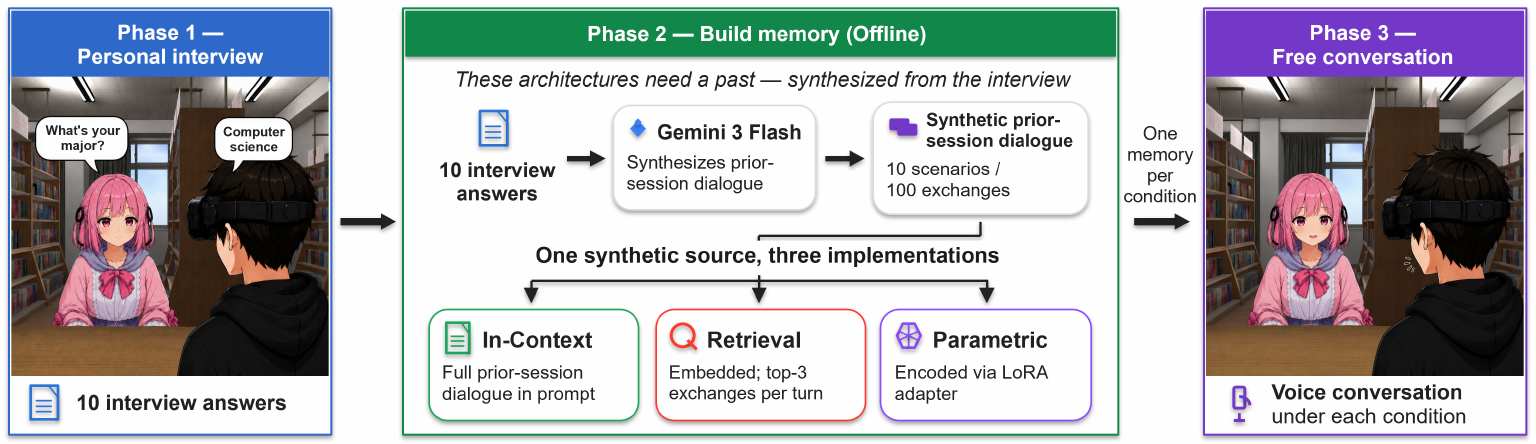
LLM-driven embodied conversational agents (ECAs) are increasingly deployed as social partners in virtual reality (VR). Sustaining cross-session relationships requires memory, which may be held in the model’s context window, retrieved on demand, or encoded in model weights. Whether these memory architectures shape user experience remains unclear. In a within-subjects study, 29 participants held voice conversations with the same VR ECA under three memory implementations, all drawing on the same participant-specific synthetic prior-session dialogue: In-Context, placing the full dialogue in the prompt; Retrieval, retrieving relevant prior exchanges from it on demand; and Parametric, using participant-specific Quantized Low-Rank Adaptation fine-tuning on the same dialogue. We measured social presence, perceived ECA qualities, perceived personalization, perceived memory, response latency, and input-token cost. The tested implementations differed in perceived personalization, memory, and intelligence. Retrieval produced the strongest sense of personalization with substantially lower input-token use than In-Context, whereas Parametric responded fastest but felt least personal and received the lowest perceived-memory ratings. These results suggest that access to more history alone need not yield stronger perceived personalization. Together, the findings reveal trade-offs among personalization, responsiveness, and cost in the tested setting, informing the design and selection of memory architectures for embodied VR ECAs.